Author: pippa@aurik.com

dominate

Why are mid-size business owners committed to build, grow and dominate in such a bleak economy?

Pavlo Phitidis drew inspiration from an event he had spoken at earlier in the week, with 119 established private businesses turning over between R15million and R200million annually, probably of an average age early- to mid-50s. The businesses crossed all sectors and were from all over the country.

Pavlo was preceded by a highly regarded economist who shared a brutally tough economic forecast. He spoke about a lack of economic recovery strategy post-Covid; to the 4 caps to economic strategy development; to the political issues marring our ability to develop our growth strategy; the kleptocracy, ongoing corruption and its impact; the rating agencies who downgraded SA, the unemployment rates – it was a devastating picture and the audience were all felt shattered by the end of it!

Pavlo’s role was to try to share insights on how to build a busines in this environment! Not an easy task.

So he started with a poll. Which asked these business owners: in the next 36 to 60 months, which of these do you want:

  1. Build grow and dominate in your sector
  2. Build, grow and emigrate
  3. Build, grow and exit for a comfortable retirement at the coast or in the bush
  4. Exit your business to get a steady, predictable paycheck

What would you anticipate the results would be?

Listen to the podcast of The Money Show on 702 or CapeTalk here to gain his insights into what the business owners’ responses say about this segment of the economy.


Pavlo ran the same poll on social media and the results indicated that 83% of the people on social media thought that business owners would be looking to build & grow to emigrate.

But in reality, 87% of the business owners polled voted to build, grow and dominate their sector. Despite having just been reminded of the appalling operating environment we are dealing with.

WHY?

  1. Mindset:

These business owners had signed up to attend an event that promised a business growth discussion. They were open to learning about opportunities.

  1. Age:

These business owners were wanting to find a different way to build, grow and scale a business – they had probably tried to do it themselves and realised what they could, and could not achieve alone. The runway is far shorter than for a 30-year-old.

  1. Necessity:

Established mid-tier businesses have too much to lose. The business owners have all their wealth tied up in their business. To realise that, they need to grow, in order to exit.

  1. Reality:

Corporates that tend to dominate a sector or industry, are too big to grow in low-and no-growth economies, but mid-size businesses are nimble enough to make the changes needed to get ahead of their competitors.

When you’ve been in a business for 20 or 30 years your value stack is deep. You have the relationships and know where the problems and opportunities lie. Furthermore they have been through a cycle, probably including the recession of 2008, and many other crises since and they know how to direct the business into the opportunity that emerges from the crisis.

convert leads to sales

Converting new business leads into real sales

MARKETING GENERATES, SALES CONVERTS

Sales and marketing are two very different activities and should never be confused or combined. Getting customers to know about you is one of the single toughest things for entrepreneurs to get right. This is why you need marketing. Effective marketing should generate new business leads.

With a firm new business lead, your sales effort becomes paramount. Successful selling sees the conversion of leads into customers. This is how you measure your sales efforts: the number of leads that become your customers.

How do I make sure new leads translate into sales?

Align marketing and sales and tell a great story

Marketing and selling are both sciences. Each compromise different activities which should be organised by the the entrepreneur into a sequence, and then set up as two systems that can be measured. Marketing and sales should never be built on the back of a personality because one person’s individual style can never be replicated.

An effective marketing effort creates an expectation with a potential customer about what they can expect from your business. In turn an effective sales effort should create a unique experience that builds trust and cements a relationship based on belief that the expectation generated by marketing will be met.

Converting leads to sales

Translating leads into sales is informed by tow core systems that must be set up in the business first.

Organise each lead generating activity into a sequence

Multiple activities should be driving leads all the time (emails, direct selling, cold calling etc) with each activity organised into a logical sequence that can be measured. For example, sending a promotional email to a database involves:

  1. constructing the email
  2. preparing the database
  3. dispatching the mail and
  4. recording the number of responses to measure the impact.


Create a selling system based on your unique offering

Selling is less about a great personality and more about creating a compelling experience for the enquirer. This experience is informed by what makes your business special and what differentiates it from others in the same industry. Selling completes the story started during marketing when the anticipation is formed is its the encounter that wins the customer over to your business.

coach

Business Consulting – From good to better – the value of mentorship, coaching, advisory or consulting

When do you need a coach, mentor, advisor or business consulting? And how do you know which is going to be the most beneficial to you and your business? Pavlo Phitidis unpacked the different options and their value on #TheMoneyShow on 702 and CapeTalk. Listen to the podcast of that discussion:


Mentorship in its pure form is learning from someone by being around them. Pavlo’s belief is that mentorship relationships that work involve a fair exchange: The mentor feels that their effort and time is being valued and that their experience and wisdom is being engaged with, argued, debated and embraced – and critically that they are learning from those engagements too.

Coaching is different. A coach is a skilled sounding board, who helps you think differently, gain perspective, who resolves challenges and helps you to find a path by asking a thousand questions and then reflecting back what you are saying. You talk to them and you hear yourself back.

Coaches hold you accountable to your intentions. They rely on you doing what you said would you do one session to the next and if you don’t – they’ll ask you a thousand questions about why you didn’t!

There’s enormous value in coaching as it forces you to create good habits that work and drive you and your business forward.

How do you know if you need a coach, mentor, consultant or advisor?

You have to understand how you behave and understand what you need support or help with:

  • If you need someone to do things for you, then a consultant is useful.
  • If you are looking for cogent direction with a challenge you’re facing outside of your expertise – it could be a tax issue or a specific transaction, then go to an advisor who specialises in that field.
  • If you’re feeling trapped in your own head, or feel that you feel you’ve hit a ceiling then a coach is for you.
  • If you’re needing to punch above your weight and reach up and out of where you’re currently operating, or to get ahead in a shorter period of time, then surround yourself with people who have advanced themselves to a significant degree and listen, learn and engage – this is mentorship.

If you decide you need a mentor then understand the experience your chosen support has. If you’re running an SME and you find a mentor who has built their career in a corporate environment, their understanding of your daily challenges will be limited.

Who needs a coach?

Pavlo shared the story of Le Bron James, the basketball player with a net worth of $0.5billion, who earns about $100 million a year. He’s in his late 30’s, which is old for a professional basketball player, and yet he outperforms the 20 year olds in his own team and across the league.

How? He spends $1.5m dollars a year on coaches: A shooting coach, a jumping coach, a speed coach, a body coach… he invests in experts to take him from good to the best. Doing well is not good enough. That is what it takes for Le Bron James to be the best.

It’s particularly difficult to see the need for support when things are going well, but that is the difference that a coach, mentor or advisor can make.

Efficient 25.11.2020

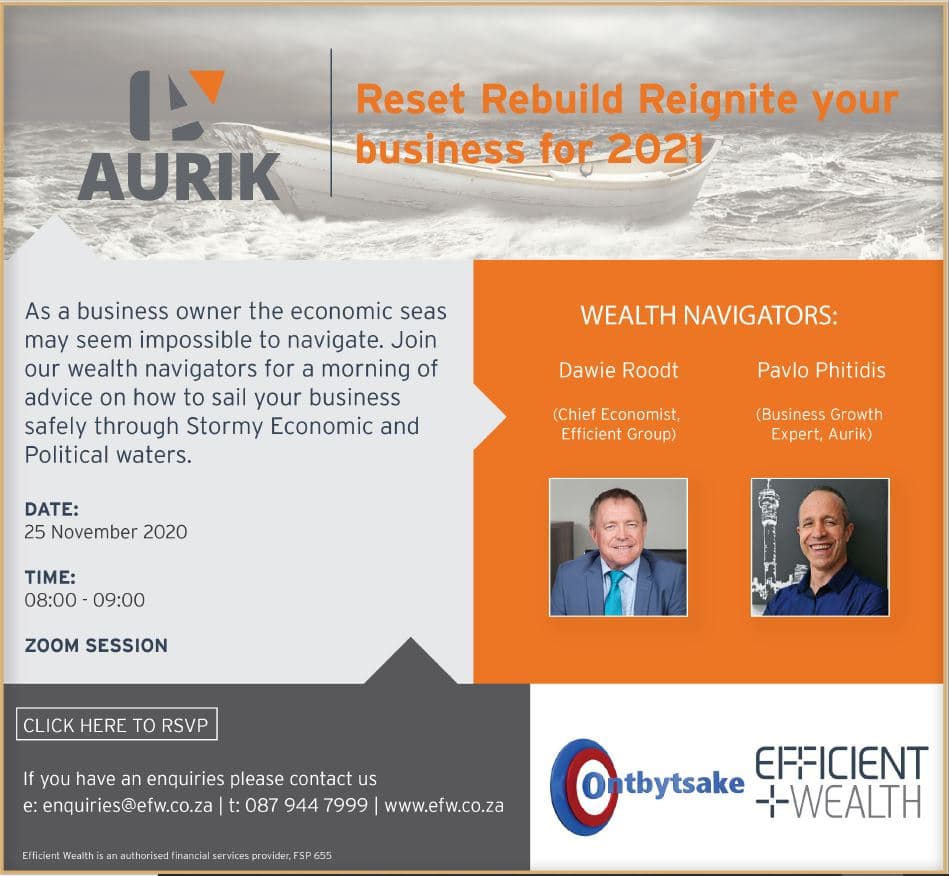
EVENT: Navigate your business through stormy economic waters

There is a way to build your business to withstand the wild waters that mark uncertain economies like the one we are in.

Join economist Dawie Roodt and business growth specialist, Pavlo Phitidis for insights into what the ocean ahead might look like, and how to build your business to thrive in any storm.

Date: Wednesday 25th November 2020

Time: 08h00 to 09h00

Venue: Online

Register HERE

business idea

Ideas are your currency, execution is your wealth

A question from David, a 702 listener “If one has a good idea however is not ready to become an entrepreneur or one’s circumstances prohibit it. How would one go about licencing their idea to a business who can use the idea and turn it into a profitable business?”

Listen to what Pavlo Phitidis said in response on The Money Show on 702 & CapeTalk:


Pavlo’s belief is that ideas are currency but execution is wealth. There is a big gap between the brilliant idea and the ability to deliver it, and the gap is where the value of the idea lies.

What is a business idea worth?

  • In the eye of the beholder – everyone who has ever come up with a great idea believes it is unique and brilliant. But you have to get the idea out of your head, to see if it provides value to someone other than you.
  • In the eye of the consumer – who is the consumer of your product and service and what do they value? Usually it is something that solves a well-defined product at a cost that is lower than the cost of the problem itself. For example if you have a dripping tap, does the cost of the leaking water, and the damage it might be doing, cost more or less than the price of the plumber to fix the dripping tap?
  • In the eye of the implementer – business ideas are inert until they are implemented. Often the idea begins and ends in the imagination of the person who came up with it and there’s not a lot of thought on how to implement it. Is it extremely expensive to bring to market? Is it genuinely unique in the market? Why would the implementer invest in your idea?

How do you build value into an idea?

Create its value stack: Value builds in layers and you need to understand the value of each of these. For example. Where can this idea be applied? Is it in a sector or industry? And then do your research to see whether it is unique, if it is, that uniqueness adds a layer of value.

Then ask, why has no-one else done this? Entrepreneurs spend their lives looking for problems in their sector, and the solution to it. So why would it not be solved yet? It might be funding, or access to a  specific resource or skills. And  if you understand this, you start giving shape to the idea.

Next, you have to understand  how you build the business to take it to market. This where you turn it from words or imagination into a product or service. Build out the process from manufacture or development, to access to market, and bringing on a customer. At each point you’re adding to your value stack as you show how you earn the first Dollar of sales.

How do you avoid the business that you pitch to, taking your idea and building it out themselves?

The way that you monetise the idea depends on the depth of the value stack. And if all you have is the idea – you don’t have a lot of value.  Non-disclosure agreements have very little worth in protecting you as ideas are easy to come by and hard to prove to be original.

Pavlo also advised that if you have a deep enough value stack, identify 3 or 4 targets who would see it as valuable, and present it in a competitive environment, to grow the value you can bring to simply providing the idea, without giving it away to the first company you approach.

Business Day TV

WATCH: Pavlo Phitidis and Aurik business owners represent the SME voice on Business Day TV

Pavlo Phitidis was asked to update Michael Avery of Business Day TV on the SME landscape in South Africa.

He invited two businesses that Aurik has worked with, to highlight his points about how entrepreneurial mindsets overcome crises all the time in business. Listen to what Karin Igesund from Packtown, and Brian Makwaiba from Vuleka Platform had to say about how they Reset Rebuilt and Reignited their businesses through this latest crisis: the Covid lockdown.

https://www.businesslive.co.za/bd/companies/2020-11-18-watch-smes-the-missing-piece-of-the-sa-investment-puzzle/


profitable customers

SELECTING & SECURING PROFITABLE CUSTOMERS

Knowing how to focus your sales efforts on the most profitable customers can accelerate the growth of your business exponentially. It is a critical exercise because, with limited resources on hand, you need to focus your efforts, to maximise your impact and build your business’ momentum. On The Money Show with Bruce Whitfield, Pavlo Phitidis outlined a useful technique for positioning your business:

KNOW YOUR CUSTOMER

As the owner of a growing business, you may feel tempted to try and be everything to everyone. This impulse is rooted in wanting to generate an income as quickly as possible, but it’s never a good idea to try and solve every problem, for every potential customer that comes your way. Finding, and knowing, the customer that you are best suited to serve, and who would be most profitable for your business, is vital.

A TECHNIQUE FOR POSITIONING YOUR BUSINESS

We used this technique with a group of technology entrepreneurs and, through it, you’ll be well equipped to find the right kind of customer for your business, and solve their specific problems. This technique will help you to build your business to be customer-centric, rather than product-centric, by positioning your business correctly. To showcase this technique, we’ll focus on the product of a tin of baked beans.

1. UNDERSTAND THE ESSENCE OF YOUR PRODUCT OR SERVICE

Undertaking an in-depth analysis of your product will help you to better understand and define its capabilities and suitability for customer groups. Create a brief, feature-filled definition of your product, isolating what it can and cannot do, what it looks like and how it works. If we look at a tin of baked beans, we may ask the following questions: What does the tin look like? How many beans are in each tin? What do these baked beans taste like?

2. DEFINE THE GROUPS OF CUSTOMERS YOU COULD SERVE

Once you understand your product, look towards discovering the types of customers it can serve. Define who the people are that your product can serve, by detailing their demographics; lifestyle; likes; dislikes, and needs. We’ve outlined four definitive customer groups who may enjoy or eat our tin of baked beans:

  1. A mom with 6 kids
  2. A competitive athlete
  3. A busy business executive
  4. An artisan worker

3. UNDERSTAND THE PROBLEMS THAT THEY EXPERIENCE THAT YOU CAN SOLVE

Each of your defined customer groups will have unique problems they face, that your product could solve. These are some of the unique problems each of our chosen customer groups may face:

  1. Mom: needs our tin of baked beans to stretch as far as possible, and for it to be easy to use when her children are hungry.
  2. Athlete: needs a healthy, high-protein meal, that has muscle building capabilities.
  3. Business Executive: needs a convenient, on-the-go meal that’s nutritious and easy to make.
  4. Worker/Labourer: needs a filling, hearty, energy-boosting meal.

 4. PLOT YOUR CUSTOMER GROUPS ONTO A MATRIX

Plotting your customer groups onto a matrix may sound complex, but it’s really a simple, four-block graph, that helps you to define your most profitable customer group. You’ll assign your customer groups into each quadrant by showing which group:

Has high or low profitability: Which of these customer groups can I serve immediately, with the product I have right now? How useful is my product to them?

Has a few, or many, members: How many of these customers are out there?

Through this, you’ll discover your ideal customer: the most reachable and most immediately profitable customer will be in the top right quadrant. For our tin of baked beans, that turns out to be the Business Executive.

5. CRAFT YOUR MARKETING AND SALES MESSAGES TO FOCUS ON THE TOP RIGHT QUADRANT

You can now focus your marketing strategy and messaging on your most profitable customer group, and find ways to communicate with them, in line with your business positioning.

6. BE DISCIPLINED, FOCUS AND PERSIST

Focus most of your marketing effort and budget on your most profitable customer groups, and remember that persistence is the key to momentum. Wealth, and the development of a successful business, is a cumulative exercise and not an overnight task. Once you’ve established a solid marketing effort that focuses on your ideal customer, you can look at apportioning some marketing effort towards the other customer groups, and perhaps even think about new product developments that may serve them best.

Do you need help with figuring out your ideal customer is, or positioning your business correctly? Aurik can assist, as we work alongside you to build your business into an Asset of Value.


turn talk into walk

TURNING THE TALK OF YOUR BUSINESS STRATEGY INTO THE WALK OF EXECUTION AND RESULTS

While the big ideas and the talk of business strategy seems easier to do, the walk of action and executing on those ideas is a struggle. On The Money Show with Bruce Whitfield, Pavlo outlines the obstacles that could be holding you back as a business owner, and how to overcome them:

PROCRASTINATION

You may have the big business strategy, the great idea, the gigantic goals, and the inspiration to attain them, but procrastination holds you back. Set too big a goal, and you may be overwhelmed by them, effectively preventing yourself from achieving any! Instead, break your big goals and idea into many small steps and then begin climbing that ladder – one step at a time. This will enable you to build momentum.

Don’t let your obsession with perfection hold you back from attaining your objectives – start with smaller goals and work your way through them, to achieve a sense of progress. With just 3 economic months left before the end of the year, you need to act and the best way to do it is to begin.

Also, holding back on action because you are waiting for a big project to land, environmental circumstances to change, or you’re concerned you will fail, won’t get you anywhere. Truth is found in action, so start acting, now.

IF YOU WANT SOMETHING DONE PROPERLY, DO IT YOURSELF

Letting go of control over the small tasks that make your business work, is imperative when you’re working on executing your business strategy. Building your business through effective delegation is important for growth, and where that has failed, look more towards hiring people as operators, and not just to fill a job vacancy. Moreover, if staff performance seems to be dwindling, look at your performance measurement systems, and re-assess how well they are working.

SILVER BULLETS

There are no silver bullets in business. Yes, you could hire new people, acquire new premises, find a new funder, or buy new equipment, but those aren’t going to generate action all on their own. Put aside the idea of a silver bullet saving your business, and set your mind towards action, rather than looking for a silver bullet.

EGO AND PRIDE

If you’re frustrated by a lack of progress in your business, and battling to implement your business strategy, it’s time to put your pride in your pocket and pack your ego away. Asking for support, help, or guidance, is not a sign of weakness; it’s a sign of strength and willingness to move beyond your current circumstances. More and more big businesses across the globe are re-assessing their business strategy and moving towards focusing on their core objectives – you should too. Outsource things that aren’t your primary business objective or area of specialization and look long and hard at the goals you want to achieve.

TIMING

The phrase “it’s not the right time” is an all-too-common excuse for delaying your execution of business strategy. Just get started! Of course, it can be difficult to measure and assess your leadership and direction in your business, especially at first, but remain cognizant of your business journey. Look for and find your business’ pattern of growth, while you focus on the objectives for that phase of your business journey.

At start-up stage, you should be focused on learning and understanding what business you’re in, defined only by the problems your business intends to solve for its customers. Moving on from that, building the business beyond yourself means you’ll need to change your leadership strategy, and lean more on implementing systems that will support your business strategy, while hiring the right people to work with those systems.

EXHAUSTION

We live and work in unsettled times, beleaguered by uncertain economic circumstances and a seemingly overwhelming barrage of bad news. This level of uncertainty is the new normal. Rather than allowing yourself to become despondent because of it, focus only on the things you can act on, control, and make happen. Focusing your energy on what is useful to you will help you to find the energy to keep moving, stay on track, and build your business. Developing a fitness for this new normal of uncertainty will mean you’ll be able to build your business, no matter what the external circumstances look like.

lock and load your business now

ACT NOW TO REGAIN CONTROL OF YOUR BUSINESS, AND GET AHEAD IN 2021

For many businesses, the Covid-19 lockdown undermined all the plans we had made for 2020. While we don’t know what lies ahead in 2021 or beyond, this is all the more reason to build our  businesses to thrive in uncertainty. Join business growth specialist Pavlo Phitidis for a 60-minute discussion where he will outline a proven methodology to build a business to deliver more revenue, profit and time, irrespective of the external circumstances.

Leave with practical insights into how you can:

  • Position your business for relevance to existing and new markets
  • Build dependable marketing, sales and operational systems
  • Focus and empower your teams to ensure performance
  • Spend more time leading rather than doing
  • Accelerate growth of revenue and profitability
  • Build the 3 levers of value to maximise exit when you get there

Date: Wednesday 18th November 2020

Time: 08h00 to 09h00 

Register HERE

engineer

Engineering and creative mindsets that build and break businesses

Building a business without either the ability to fix something or create something (preferably both) is truly hard.

An engineering ability, using math’s and science to solve problems and/or a creativity ability, the tendency to generate, possibilities and alternatives to solve problems are key talents that enable a business to attain validity. Afterall, a business exists and sustains by solving problems for customers!

Without these skills, its hard to make a business happen. However, if these skills are not contained and directed as a business grows, the business will simply become a job for its creators and never build into an asset.

Listen to the podcast of Pavlo Phitidis’ discussion about these business mindsets, from The Money Show on 702 & CapeTalk:


What is the difference?

A job is something that operates only with you at its center and meets only 1 of the three criteria of an asset.

An asset has three criteria. Capital/equity value that can grow, income value that can grow and tradability to allow its sale so that the capital value can be realized.

How do these talents/skills need to be directed over time

All businesses go through a development cycle. Usually, this is determined by time. You start, build, grow, accelerate, reach prime, mature and decline. For the average business, in fact for the majority of businesses, they start, build, grow and then move into a repeating cycle of build-grow into perpetuity before they close.

Often, the guilty party enabling this is the exact talent that enabled the startup – the engineer/creative.

Why does this happen?

Psychologically, this talent finds meaning in solving or ideating solutions to problems. There is a thrill and ego bump every time it happens. It can be and often becomes addictive to the point where many business owners are not even aware that this is operating.

Talent in engineering/creative abilities create unlimited timelines. Because you can fix things and do so repeatedly, you can always start again, do it again, recover again after the last effort. This puts you in a position where you can earn income repeatedly because of your talent so you simply just continue.

The talent does not get redirected and channelled differently. In as much as it takes an engineering/creative talent to solve a problem, the exact same talent is required to build a business. Think about what a business is – it is a legal person, that contains systems and operators that serve customers by solving problems for value through a commodity or service. To start you need to have a commodity to trade – a product/service. To grow, you need to wrap it into a business.

From a Job to an Asset

The redirection of these talents needs to come at a point where you can delegate responsibilities to your employees. To get this right, you need a simpler business, that can be driven by systems and enabled by people. Delegation is impossible without a system and a system cannot be built reliably if the business is trying to be all things to all people.

The building industry is a great example as is the advertising industry.

Less is more and simplification is key. Understanding this lets an engineer or a creative redirect their talents away from product or service solutioning to building the commercial wrap to take the product or service to market without them.

This business is no longer a job and now is an asset. A buyer looks and will find capital, income growth and to make it all tradable, independence of you!