burnout

IDENTIFYING AND PREVENTING BURNOUT WHEN YOU’RE A BUSINESS OWNER

Burnout creeps up on you like the Dementors of Harry Potter fame. You may not see it at first, but it slowly takes over and, when it hits, it can devastate your body, mind, life, and business. Burnout can destroy even the strongest businesses and the best business owners. On The Money Show with Bruce Whitfield, Pavlo Phitidis discusses ways you can identify, prevent, and manage burnout as a business owner:

IDENTIFYING BURNOUT AS A BUSINESS OWNER

If you’ve read any of the Harry Potter books, or watched any of the movies, you’ll be familiar with the Dementors. The Dementors suck the hope out of characters in the series, leaving them feeling listless, tired, and despondent. Unable to identify exactly what’s making you feel this way, you end up disillusioned, unable to focus, and – seemingly suddenly – you’re completely adrift. Burnout works much like the Dementors and business owners are at high risk for burnout. As a business owner, you’ve invested passion, energy, time, and money, into your business, often forsaking financial safety nets, and putting your personal life on the line, to build your business.

HOW BURNOUT MANIFESTS

Burnout begins to manifest through negative thinking and forecasting. As a business owner, you’re an optimist – if you weren’t, you would not have started your business. Burnout manifests slowly, and then speeds up, to the point where you may feel you can’t even get out of bed in the morning. When negative thinking starts to creep in, you may find your creative abilities falter, and you pay less attention to the tasks in front of you. You care less than before, and standards start to slip within your business. You may find yourself apportioning blame to people or circumstances when things go wrong, rather than trying to own and solve problems. You may find yourself battling to lead your team, and your willingness to fight for your business diminishes. Physically, your body starts to react, with interrupted sleeping patterns, sudden weight loss or gain, and your energy levels plummet.

HOW TO PREVENT BURNOUT AS A BUSINESS OWNER

Staving off the onset of burnout is important for you as a business owner. You may have numerous personal strategies for managing your energy levels, to ensure that you’re able to keep going, no matter what. But, safeguarding your business from burnout is vital, so that you can keep growing and building, no matter what. Build your business to be burnout-proof by:

  • Building differently – Don’t try to be all things to everyone. Burnout typically takes hold during the start-up phase (the first 3 to 5 years of a business journey), because it’s during this time that a business owner focuses on attracting customers and getting significant cashflow rolling. Because they’re so focused on trying to solve multiple problems, and be all things to everyone, they’re not able to build a solid system of delivery, and every functioning part of the business needs their direction.
  • Simplifying – The simpler your business is, the easier it is to manage and grow. Simplifying your business at all levels, reduces the noise you need to contend with daily, and helps you to focus.
  • Creating a system of delivery – A reliable, measurable system of delivery that ensures you deliver what your customers need, when they need it, will help to buffer your business against burnout. With the right, well-capacitated, people in place, your business can continue to deliver even when a business owner is battling burnout.
  • Getting some help – There’s no shame in asking for help. Culturally and societally, we’re somewhat conditioned to believe that asking for, and receiving, help, is a sign of weakness. In truth, however, asking for help is a sign of strength. Your family may be a source of additional pressure, but your spouse should be able to support you in some way. If you have a business partner, it’s time to ask for their help – they probably saw the signs of burnout in you, long before you did. Map out a plan of growth for your business, and for yourself. Exercise, eat, and sleep well, and try your best to get some perspective, so you can stop burnout from burning you, and your business.


pivot

Pivot: what does it mean and how to do it

It has become one of the worst pieces of jargon through the Covid-19 pandemic and lockdown, and one that Pavlo has steered clear of. But at its simplest, the word pivot means you need to find revenue from a different place and space.

The word was popularised 15 years ago on the West Coast of the USA where the startup industry was booming. Investors into that market were engaging in what is called portfolio investing, but which Pavlo calls ‘roulette investing’ – throwing money at a host of business plans and ideas. When these failed, the investor would ask: ‘What Now?’ and the startup would say: “We have to pivot”. And this is possible in the startup environment because they have nothing to lose as they haven’t built up a legacy business.

It is very different when you have an established business with the baggage of your business, in these instances, you need to pivot very differently.

Listen to Pavlo discuss how establish businesses did, and should pivot on The Money Show on 702 & CapeTalk:


To make his point about how different businesses pivoted, Pavlo reminded us of a massive phenomenon at the very beginning of lockdown: everyone was stockpiling toilet paper. Why? His view is that in a crisis, the fist thing we do is to ACT to avert the crisis, we do something, even if it is misguided to make us feel as if we have some form of control over the crisis.

Pavlo witnessed similar behavior among business owners. He saw established businesses making pivots based on their own biases. Their history and legacy were affecting their decisions and actions as they tried to find ways to bring in revenues.

The first grouping were those businesses that had invested plant and equipment that the business owned. Consider a fleet of trucks, or workshops or fridges. The tendency was to look at the equipment lying idle, and figure out what they could use that for to make something new or store something different.

Very often those types of businesses are run by people with an engineering background, and these are people who are good at working with their hands… making something or doing something. So making or doing something new was their place of safety – their toilet paper stockpile.

The 2nd pivot grouping was with those who had created their own product or service. Whether it was baked goods or a scientific invention, or a service innovation. These business owners went back to their product or service and figured out how to make the product or service better. Whatever their strength was, they focused their energy there, that was their safe space.

Finally there were pivots where business owners moved towards their customers and suppliers. They sought to understand what those suppliers were doing differently, and how they needed to pivot to be relevant to them.

Pavlo believes that going to your customers is always a good idea as that is where the revenue is going to come from first. And he shares a technique you can apply to get it right.

The Onion Peeler:

Pavlo has developed an incredibly simple but effective technique called The Onion Peeler to understand where your strengths lie in your business.

Every business has a core and strategic competence. It might be in your services, skills, or with your customers. Without it you don’t exist at all as a business.

The middle layer is not core but absolutely strategic. For example – technology, accounting, inventory management or whatever it is that enables your business but is not what your business does.

The outer layer is what you can shed, it is not core nor strategic. You can buy it as and when you need it.

If you apply this to your approach to pivoting – take what is essential to your business and take that to your customers and ask them what has changed about their needs that mean they no longer need your core offering, in the same way.

The customer that guides your pivot will be the first one to pay for the pivoted offering.


5 post covid syndromes

5 post-Covid business syndromes that could hurt your business

Through thousands of discussions with business owners, Pavlo has identified certain patterns among different kinds of business owners. Most are severely on the back foot.

His concern is that if you have a prolonged view on the current environment, the psychology you hold today can change your attitude and patterns of behavior, which affect the habits you make in the next 18 months or so, which could mean in the next 18 months to 2 years you could end up being a significantly different person to who you are today.

Listen to the podcast of Pavlo’s discussion about the 5 syndromes affecting business owners, from The Money Show on 702 & CapeTalk:

It’s important to understand that psychology, and work through it or work with it, to get through the next 2 years.

The 5 mindsets that he is seeing over and over again are:

Loss aversion

This is a view that assumes that losses loom larger than gains. You see losses running out of the business, but you simply cannot see the gain that will outweigh the losses you are experiencing now. The problem here is that you have to change to remain relevant, post-Covid. The extent to which you test and invest in new technology, for new engagements with clients and suppliers, scares a lot of businesses that are experiencing this. They can’t face the enormity of the task and freeze, unable to act. Sadly, your competitors are, and when you emerge from your frozen state, your customers, clients and suppliers will all have changed and you will be left behind.

Panic

When you panic you move into a Freeze, Flight or Fight response – this switches on an automatic response which narrows your perspectives and point of view. It is an impulsive state. An example is a business owner who decides that Covid is here to stay, and so the business needs to cut costs to staunch the bleed of money. Where do they cut? Sales and marketing, which stops the flow of leads into the business, which cuts revenue, and exacerbates their panic because now they actually are losing money.

Imposter syndrome

This is the voice inside your head that makes you feel like a fraud, who will be found out soon enough. Pavlo’s rule of thumb to identify the frauds is to look at what they say vs what they do. Pavlo suggests persisting with a question to get a deeper and deeper view – if someone brushes you off… they may be an imposter.
But right now, not a single one of us knows the answers! Simply saying”;I don’t know, what do you think” helps us move past that place where we feel we need to know all the answers all the time, because people see right through it when we pretend we do.

Denial

This is often expressed as a dependency on one area where you feel strong and capable and you won’t move from it. You obsess about that. But doing the same thing again and again and expecting a different result was Einstein’s definition of insanity. Technical experts are doing this a lot. Brilliant scientists and engineers and specialists will act where they can physically do something – they dabble and fiddle with the product or the service, without engaging the market to see what is actually needed. Making a product ‘better’ without knowing what your customers’ needs are is insane.

Exhaustion

Private business owners work 35% more hours in a week than employees, so already they were tired. But Covid has forced them to learn, adapt, cut, find new revenue streams which has compounded that.

Burnout in yourself or your business can be devastating so if you are truly exhausted or find yourself manic, which often leads to burnout, Pavlo’s advice is to go for a run, or a ride, or a stroll with the dogs. Take a break to manage yourself, before you get back into it.


If your business is suffering due to these psychologies, contact us for a fresh perspective and a trusted partner to reignite your business.

ship

Building a business is like sailing a ship

Analogies are very useful to simplify thinking and action. As a business owner, building a business in a challenging environment creates noise and chaos. Gaining clarity, certainty and confidence helps manage the noise and emotion to provide right action and timing in your journey of building your business. A good analogy helps you get this right.

Building a business is like sailing a ship. Here’s how and why.

  1. A ship sets sail with a clear destination in mind

Like a business, you start and end. The end takes one of two forms: A sale or closure. For most, its closure. In fact, 94.6% of all businesses started close at great cost to the business owner, their family, their staff, suppliers and customers and the economy in which they operate. To succeed in your journey, you need to set a clear destination. You then need to ‘chart your course’ to arrive there safely and efficiently.

For example, you set sail from Durban to get to Mumbai. It’s a 12-day journey at sea. Being smart, you take 15 days of food, fuel and water in case things go wrong. A business too, should have a resource plan to get from where it is to where its going. This means a clear destination and a plan to get there supported by a budget.

  1. A ship has a crew with specific skills and roles

A ship has a crew made up of people with varying skills and responsibilities. There’s the Captain, first and second mate, navigators, engineers, cooks and deckhands and so on. Each has a specific role to perform and is trained to perform it.

A business is made up of people too. If well organised, the team includes people best suited and skilled in marketing and sales, operations and procurement, human resources and finance. At sea, every crew member knows what to do and when to do it. The safe passage of the ship depends on it. In a business, the same applies. Failure in any one area of activities stalls your business growth and lets all your team members down.

  1. A ship is organised in three distinct areas: a bow, midships and stern

The bow of the ship is like the ‘front-end’ of your business. It breaks new water and directs the ship along its course. The stern is like the “back-end” of your business. It propels the ship forward. The midships is the control centre of the ship located between the bow and the stern. It’s like the “middle” of your business and controls the finance and human resource administration and management activities. Each area must perform its role for the ship to function well and sail successfully to its destination.

The same applies to your business. The front-end of your business: sales and marketing, leads the business direction. The back-end of your business delivers in response to sales made. The midships holds and coordinates everything together with hopefully, good metrics and data to be sure that there are sufficient resources to get to the destination.

  1. A ship has a bridge and engine room

The engine room of a ship is below deck and houses the diesel engines that drive the propeller and move the ship forward. Its mostly a dark and dingy place. The loud noises of the engines smell of diesel, it’s poorly lit and the constant issues that a sea faring ship experiences make it a tough place to be. The bridge of the ship is located above the deck at a high point on the ship. It has windows wrapped around it giving you a 300-degree view. It has a dashboard with instruments and navigation equipment. It controls the direction of the ship, it deals with speed and communications and has a Nespresso machine. It’s a great place to be.

As a business owner, where do you spend most of your time? In the engine room putting out fires or on the bridge guiding the direction and growth of your business?

Most business owners I meet are spending most of their time in the engine room. They are driven by the business and everything that makes up their business. Staff, customers, suppliers, landlords, government and more. They spend little time on the bridge because their businesses are chaotic and poorly built, requiring them to be constantly fixing and rejigging the engine room. Yet, they are the most expensive resources in their own businesses. They should be spending up to 70% of their time on the bridge. There, they can direct the ship, set the course, ensure that they get to the destination to off-load their cargo and get paid. There, they drive the business and are not driven by it.

  1. A ship sails alone in the open sea to get from A to B

The open sea is full of surprises. The waves, wind, currents and storms bash the ship and threaten its safe passage. The business environment is no different. Every day we face political regulation that hurt business, volatile currency, uncertain energy supply, bad behaviour and hectic competition. It’s a rough sea indeed.

  1. A ship is regularly maintained

A ship is an asset that if well maintained, earns income for many, many years. Regular maintenance from scrubbing the hull free of the barnacles that create drag on the ship’s momentum to removing rust and replacing the lifeboats and distress flares all improve the performance and sustainability of the ship.

In any business, the systems you build will have to be partly broken and rebuilt as you grow. The software and computing you have will need to be upgraded. It’s a process of continually ensuring that your business, as it grows, is shaped and tweaked to deliver continual performance.

  1. Build your business like a Captain sails a ship

Using this analogy, be sure that you have a clear, well-defined destination to sail to. In my view, the only port you should be sailing to is an #AssetofValue. That is a business that’s well-positioned, driven by business systems operated by a well-organised team. Importantly, an #AssetofValue can be successfully sold at any point. Importantly, it releases time for you, the Captain of your business, to be on the bridge.

The shape of your business from the front, middle and end should be well designed to ensure that your ship sails successfully and efficiently. That design coordinates the activities in the business for your crew to play their role. That crew should be well-selected and trained, only possible if the destination is clear and ship is well built.

The sea you sail through will have surprises and your being on the bridge of your business lets you look ahead and keep a clear mind to cope with them as they batter and bash your business.

Finally, you, the #businessowner, should be on the bridge. Its only there that you can grow your business beyond yourself, organise your team, coordinate the building and functioning of your business to ensure that, when you reach your destination port, you have an #AssetofValue. It’s at that destination port you can unload your cargo, or in the case of your business, you can exit with a successful, clean sale.

Working with Aurik we have a structured approach to help any established business owner build their business like a ship. We work with you from the bridge to set a clear destination, build the ship of your business to get there and with the right crew. With us you will get to the bridge and remain in it to take control of your destination and secure your eventual, successful exit.

mindsets

Winning mindsets turn thought into action and action into results

The world changed virtually overnight when COVID-19 entered our lexicon. The distinguishing feature between business owners who crack it and those who drift along, and fail… is mindset.

There are 17 mindsets that I have observed, working with more than 2 500 business owners as well as on 43 businesses that we have invested in. In this blog, we will talk about 7.


#1 Attitude to outcome

Mindset, or attitude, is the only thing that you have 100% control over. It governs your behaviour which manifests your lived experience in the world. If your business is failing, it’s not your brain, nor your position holding you back, it’s the wrong mindset. And changing it is 100% in your control.


#2 Truth in Action

We live in a world of great uncertainty. Truth in what works and what doesn’t only comes from deliberate action. If you don’t act, you will never know. If you follow someone else’s advice in big moves, you will most likely fail. If you don’t, you will never understand how and why you succeeded. That builds an uncertainty trap that becomes very hard to escape. I have seen many people make big money on opportunistic deals. Their efforts to repeat the process failed consistently. This happened because the construction of the deal, the timing, the circumstances and the many, many failed deals leading up to the successful deal that they were invited into – was lost on them. Opportunistic deals are just that, once off. I have also seen how these deals affect people’s confidence. In an opportunistic deal, you believe that the money you make is the only money you will ever make, and that luck was on your side. Contrast this to the the grind of building a business, the multiple failures and hard lessons that eventually lead to success. These are your lessons and can never be taken away.


Lastly, there are so many variables in the world today. its impossible to find a sustainable formula for success. for this reason, many small, consistent steps make for a better, more sustainable outcome. In Kung Fu, I was taught to jump from a 3-meter height. It began in year one learning how to jump and land from a 50cm box. In year five, I landed perfectly from 3m having practiced it over 5,000 times a year. without that practice, the first jump would’ve broken bones and spirit.


#3 Earn your Rights


Two years ago, I addressed an audience in Detroit, Michigan. This is in the American rustbelt heart land. There was an audience of about 200 people. One audience member got very agitated with me. I stated the fact that we are never victims if we hold the right mindset. Blame is an excuse and it’s avoidable if you act, since action empowers you to take control and create a new reality for yourself. He angrily objected to this. His grandfather had worked for Ford Motors and so did his dad who followed in his steps. He too, then followed and worked for Ford until he was let go. That was 5 years back and he and his family were struggling. I debated delicately with him. Being unemployed is a terrible circumstance. I argued that he was in control to the extent that he had the ability to re-skill himself. And that he could do this largely for free through the internet. Re-skilling would keep his skills and capabilities relevant to the digitising industrial space that he lived in and wanted to work in. A tough approach but, the only approach.


#4 Excellence in your Domain


In early March 2018, I went to watch the Cleveland Cavaliers play the LA Lakers in Cleveland, Ohio. Le Bron James played for the Cavaliers then. He was incredible to watch. He is also one of the oldest players in the game and the sixth highest paid athlete in the world. He invests deeply in himself to maintain his status as the best basketball player in the US. He spends $1.5m on maintaining his performance levels. He has coaches for everything from gameplay to joints, nutrition to recovery. He eats, lives, thinks and dreams basketball and never, ever, veers away from it. He has his 50, 000 hours and 5,000 mistakes behind him because of that. He also has a natural talent and affinity. Find something you love, and you’ll excel too.


#5 Play the Percentages


Kevin van Dam is a happy person. He fishes freshwater bass for a living. He makes $10m a year. he has the fastest boat on the competition circuit, the most rods, reels and lures when fishing on the water and he has mapped the freshwater lakes of America to keep ahead. The 39m registered bass fishermen in the USA love this man because he always, but always keeps on winning. He wins because of his obsessive, compulsive, perfection disorder. It means he takes no chances in a very competitive sport. He seeks, finds and works hard to shave an additional percentage point here and there to favour his performance. Those many small constant improvements stack up and give him a constant 4% to 7% advantage per competition. He does this because without it he would lose $10m a year.


#6 Trained Brain


Training your brain is becoming increasingly necessary. Like a muscle, if you don’t use it you will lose it. The gig economy already means that here, in SA, we can access some of the biggest talent in the world and if you can’t compete, you won’t eat. The winning attributes for the future include creativity, collaboration, critical thinking and communication. Process work, technical work and any other work that can be delivered by software and computers on phones and robots will make you irrelevant. You simply won’t be able to compete.

These attributes place you far out of reach of the software and robots that are your future competitors.


#7Paniym


Recently, I had a feisty debate with a Rabbi. The whiskey was being poured, the conversation was accelerating and we debated for some time the idea of Paniym. This is a Hebrew word for two faces. He argued that you have a public face which is public property and a private face which is yours to keep. Because you live and work in the world and because opportunity comes through people, your face is public property. It should create the best experience for whomever you meet and engage with to create the best outcome for yourself. It’s about being conscious and in control. You generally only have one shot at creating a likeable, engaging impression, one that would favour your being invited into opportunities or finding favour for your proposals. We are human and we work with people we like.


I consistently see these mindsets live and in play with the successful business owners that I work with. These mindsets are available to us all, choose them, use them and improve your chances of success.


You will experience these mindsets live, everyday you work with us at Aurik. Our work with you will see you working with many talented facilitators. Their behaviour and their actions will reflect these mindsets. Mindsets that will become part of how you think, act and build your business.


Gameplan

Hope is not a strategy

While hope is a central tenet of an entrepreneurial mindset, hope alone is a promise without guarantees. In this podcast from The Money Show on 702 & CapeTalk, Pavlo Phitidis puts forward his argument that you cannot rely on hope, you have to have a plan to get whatever it is you are hoping for.

You can’t become a business owner or a good entrepreneur unless you’re optimistic, and believe in your ability to deliver something better than it has been done before. It is baked into the psychology of business owners.

What Pavlo does find concerning, is the number of established, successful business owners, 20 to 30 years into their business, who are ‘hopeful’ that they will be able to sell their business in the near future. Yet statistically, 94.6% of businesses started, fail to sell. Hard work and hope alone, are not enough.

A good entrepreneur prepares for the worst and hopes for the best. And it is this preparation that makes the difference. Pavlo shared an example of a business that has gathered a highly qualified team of extremely specialised scientists. They are all mature, they all come with impressive value stacks – wisdom, connections, insights and foresights.

The have created a digestible piece of blockchain technology that stands to resolve many problems for many businesses. But they have pinned their hopes on one of the 4 giant multinational consulting clients to adopt their tech. They have been waiting 6 months for that multinational to make a decision on their business. In the meantime they have no revenue coming in and are running out of runway.

The problem is that they have pegged their hope on something outside of their control.

While we sometimes have to rely on others, and elements beyond our control, hope has to turn into a plan rather than just a wish. For example, they could have pitched their concept to 30 big multinationals but putting all of your hope in one external factor or entity is too risky.

You have to plan now, to sell your business when the time comes

Most business owners invest approximately 48 000 hours in building their business, and yet only 30 to 100 hours go into selling it. We hope there will be a buyer when we are ready to sell.

Often the business owners don’t even know what the business is objectively worth – they see the value in what it is worth to them, as they have lived through the business.

They need a plan that is actionable, measurable and achievable!

Pavlo Phitidis

Book review: Reset Rebuild Reignite, how to build a business to thrive in a crisis

There’s nothing like a crisis to expose the cracks in a business, and there are reasons why some rise to the challenge and others can’t or don’t. In his new book, Reset Rebuild Reignite, Pavlo Phitidis shares stories of those businesses that successfully weathered a storm, as well as practical insights and strategies to build your business to do the same.

He was interviewed by Bruce Whitfield for the Business Book review on The Money Show on 702 & CapeTalk. Listen to the podcast from that discussion:

The book is now in stores and you can get your own copy to learn how to build a business to thrive in any crisis. https://aurik.com/pp-books/

ecommerce webinar

WATCH: How to thrive in a crowded e-commerce space

[vc_row][vc_column][vc_column_text]Digitising an established business to generate revenues through e-commerce needs to become a key element of your strategy today. The technology is now easier and more affordable to make it happen than ever before. What it takes is a good commercial strategy and understanding how your customers behaviour will change as a result of an e-commerce offering.

Pavlo hosted a one hour discussion with a business that needs to implement an e-commerce strategy and a panel of experts to walk through what needs to be considered, and how to get it right.

Watch the session, presented by Payfast and Business Day SME Matters:


With attention paid to B2B and B2C, the session offers practical, actionable insights to assist any business looking to establish or improve their e-commerce offering.

NEXT SESSION: DIGITAL MARKETING
Sign up for the next session, where Pavlo and a panel of digital marketing specialists will discuss how to market your brand in a noisy digital marketplace. Register here:[/vc_column_text][/vc_column][/vc_row]

Asset of Value

Asset of Value strategy series

THE ASSET OF VALUE STRATEGY SERIES

Welcome to the Asset of Value Series.

As part of the Nedbank Business Accelerator Campaign with 702 , our CEO Pavlo Phitidis, produced a podcast series to help successful, established entrepreneurs get to the next level. At Aurik we do this by giving business owners like yourself the opportunity to share your stories and insights, and in turn, we work with you as the business owner to drive key changes necessary to accelerate your business. In the Asset of value series, we explore your journey to building your business into an Asset of Value.

Episode 1: Building your business into an Asset of Value

Every business owner invests time, money and effort into building their business. Whilst passion is important in achieving this, it’s not enough. The purpose behind this investment should be clearly stated and that is to build your business into an Asset of Value. What is an Asset of Value, why is this important, how do you do it and what will you gain from it!

Episode 2: Measuring your Asset of Value

When you build your business into an Asset of Value, understanding how to measure your progress towards this goal is important. To do this, you need to understand how your business would be valued by a buyer. This could be a private buyer or corporate buyer, an investor or, if passing it onto the next generation, family or staff through a management buy-out. Understanding how valuation works, gives you control over the future value of your business. There are three levers that you can “pull” to get your business valuation right. What are these levers, how to I build them into my business and what impact will they have on building my Asset of Value.

Episode 3: Creating a customer centric business

The first lever of valuation, how far into the future will my business generate revenues, is answered by defining who the customer you serve is! How do you find these customers and more importantly, once you find them, how do figure out how to get them to buy and stay with you?

Episode 4: Building a systems-driven business

Are you building a business asset or have you simply built your business into a job for yourself? It’s easy to test. If your business cannot function without you being there, that’s a job. If it can function without you for 3 or 4 weeks, it’s likely an asset. The difference between them are business systems. The activities that enable your business to generate customers’ enquiries, win over customers and serve them in a manner that they stay are examples of systems. This is called a System of Delivery and its impact on your business valuation is profound.

Episode 5: Developing a risk managed business

Putting all your eggs into one basket is not a wise business strategy. The environment of business today is so unpredictable, one stumble and you trip and fall – all your eggs are broken. A risk managed business is one that has multiple customers, that enjoy being served by your business and are found in different sectors. Should one sector struggle, the customers in the other sectors keep you going. It’s also business that has no customer responsible for more than 10% of your revenues. Should they stop using you for whatever reason, your business continues. Imagine if they were responsible for half your revenues? With a risk managed revenue profile in play in your business, it makes you a price maker, rather than a price taker in the event of a sale and has a huge impact on your business valuation.

Episode 6: Employing the right people in your business

Once you have a clear sense of who your customers are, how to service them and a System of Delivery in place, you are ready to employ responsibly and effectively. Think about it, we mostly employ people to do a job. What is that job, what are the activities that that job should perform, can they be measured, what’s a fair salary for that job? These questions are seldom asked and answered when we, under pressure with too many things to do, reach out for help and employ someone who we hope is right. And they are often wrong. How do you employ the right people to do the right thing at the right time and at the right price when you build your business into an Asset of Value?

Episode 7: Driving your business to the next level

We hear this expression “the next level” often. What does it mean and how do you get there is often left unanswered?

Episode 8: Succession planning in your business

Wealth is cumulative and time based for most of us. We often start our businesses with very little and it takes time to grow them into valuable assets. Often, to grow them into significant assets, it can take a second generation. This could be family or staff that we pass the baton onto to get the business to its next level. How do you do this and what approach can be adopted that makes the founder and successors ensure that the business gets the best from them both, that the founders wisdom is passed on successfully and that the successors ideas are adopted to keep the business relevant and contemporary with the inevitable\ changes in the business environment.


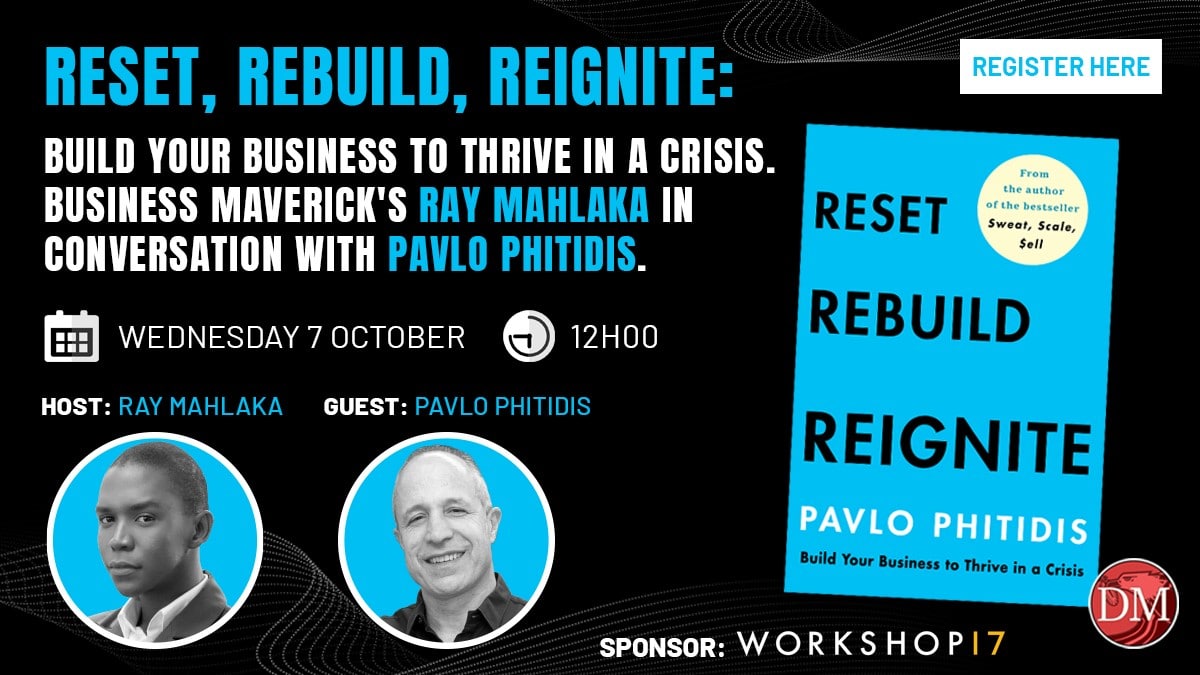
Reset Rebuild Reignite

Businesses that have taken the right actions are already starting to recover… and a book that shows you how to get this right

While most people learnt to bake banana bread during lockdown… Pavlo Phitidis wrote a book. His second book within 9 months!

Listen to his discussion on 702 and CapeTalk about the book, and how it relates to our economic recovery:

The book, called Reset Rebuild Reignite, was born out of the hundreds of conversations that Pavlo hosted and participated in with other business owners during the early days of lockdown. Thinking about what we do as businesses in a time of crisis he realised that as South Africans we have become remarkably crisis fit and resilient.

In many other parts of the world, pre-Covid, you could quite simply and easily open shop and trade. These businesses had not suffered in a zero growth economy, with load shedding and all the political turmoil we face everyday. We take it for granted that we have an innate ability to cope with uncertainty.

In business, in effect we move from one crisis to the next and the next. Pavlo remembers burst waterpipes destroying all the stock in one business he ran. Or splits in partnerships that ruin a business, or a major customer who goes under.

Change brings opportunity

It became clear to him that there is a mindset and strategy that can be applied in any crisis. The word crisis means a change of state of health, and change means a shift in the status quo, and a shift in status quo is the crack that opens up opportunity. As business owners we need to learn how to see it, read it and engage with it.

In Reset Rebuild Reignite Pavlo’s starting point is that in crisis there is opportunity. If we look at the Economic Clock, everyone pours money back into the system during a crisis. We’ve also seen that SMEs who took the right action, stabilised and most importantly, at the end of last month, that SMEs that made the right calls, hit the bottom and are now starting to grow again.

The common threads among businesses that took the right actions include, when things change, what you did pre-crisis can’t work in a changed environment. You have to change. This is the Reset phase. Among the things you can do is codify your changed customer behaviour.

Recovery

Whether the economic recovery is a V, W, or Nike Swoosh, Pavlo’s approach has always been, and remains, that the right actions are more important than the economic circumstance.

In each industry, you have three tiers:

  1. Early stage start ups, which are right on the edge of survival.
  2. Mid-tier SMEs, classically between R10m and R250m
  3. Corporate businesses

Depending on the size of your business, the shape of your recovery is going to be different. From a corporate perspective, that shape is fundamental. Corporates keep restructuring to meet the shape of economic growth, but it takes a year to change, they need economic GDP growth to stimulate their growth.

The smallest businesses are simply struggling to stay alive.

Mid-tier businesses, with the right mindsets and actions, is the tier where we are seeing greenshoots of our economic recovery. The mid-tier business that reset and rebuild now, will be at the forefront of growth next year, relevant in their market and primed to take advantage of opportunities.

If you reset and rebuild now, by next year you will have made the tough decisions and choices, resetting your team, keeping the people you could afford to keep and sadly letting go of those you could not. You will find yourself in an economy where 30% of your competitors no longer exist, you can buy stock for 30c in the Rand, plant and equipment for 40c in the Rand, acquiring smaller businesses, absorbing new staff and customers, access to new markets. Opportunities are out there.

Get the book

Find out how to Reset Rebuild and Reignite your business in the book, for details of where to buy, visit https://aurik.com/pp-books/