Author: Lindokuhle Ntombela

Stop guessing, start growing, commit demand before you invest

Elite Business: Stop guessing, start growing, commit demand before you invest

In this article, originally featured in Elite Business: The wrong sequence kills growth. Commit demand first, then build capability that scales without burning you out


I was sitting with a manufacturing business recently. Good product. Solid reputation. Skilled people on the floor. But like many businesses I see, it was working far harder than it should for the returns it was getting.

For them, and many businesses, one missing capability was the bottleneck to growth. It’s the equivalent of having a powerful engine but a blocked fuel line.

Fix that one constraint, and suddenly everything flows faster. Orders move quicker. Waste drops. Margins improve. Customers notice.

In their case it was set up times. The hours before production starts and delays between jobs. The small inefficiencies that multiply across thousands of units.

If your system takes too long to get going, you burn time and cash before you’ve even created value.

Now here’s the pattern:

A business spots an opportunity to solve that problem. There’s a component, a process, or a capability that could dramatically improve speed, quality, and consistency for customers. It’s not glamorous, but it matters. A lot.

So the owner thinks: “If I invest in this, the market will come.”

That’s where things go wrong.

“Build it and they will come” is not a strategy. It’s a gamble.

And most established business owners can’t afford gambles anymore. You’ve got payroll, customers, and families depending on you.

The smarter play is to flip the sequence.

Commit first. Then build

Secure demand before you invest.

I’ve seen too many owners buy machines, hire teams, or expand capacity based on assumptions. Hope is doing the heavy lifting. Then the pressure starts. Debt needs servicing. Capacity sits idle. Stress goes up.

Instead, sit down with a handful of key customers. Not dozens. Two or three is enough.

Ask a simple question: “What would make you move meaningful volume to me?”

Get specific: Price. Lead time. Quality. Reliability. Then make a counter-offer:

“If you commit that volume, I will build the capability to deliver it.”

Now you’re not guessing. You’re building on something bankable.

A second component of this is one most owners resist: You can’t scale a business that sits on your shoulders.

If growth depends on you pushing every deal, solving every problem, and holding everything together, you don’t have a scalable business. You have a job that’s getting heavier.

So as you build new capability, you must build the team and structure around it. Clear roles. Defined processes. Accountability that doesn’t route back to you.

Committed demand; targeted capability and a strengthened team sees something powerful happening.

  • You reduce risk.
  • You make funders more comfortable.
  • You create momentum that doesn’t rely on constant effort from you.

If you’re feeling stuck…working hard but not moving forward, don’t look for a silver bullet, look at the sequence.

Don’t build and hope; Commit, then build.

By Pavlo Phitidis

Elite Business: From commodity to control: how to escape the price trap

Elite Business: From commodity to control: how to escape the price trap

In this article, originally featured in Elite Business: Businesses can move beyond price competition by solving higher-level client problems and building structured, recurring revenue models.


Most businesses don’t struggle because they lack effort, skill or brilliant offerings. They struggle because they’re competing in the wrong game.

Consider the owner of a £10-million business in a fiercely competitive industry. Low barriers to entry. Endless competitors. Constant price pressure. Wild swings in revenue.

On paper, the business supplied branded collateral and event support. In reality, it was trapped in a commodity war as every client discussion ended with price.

Here’s the hard truth: if every conversation ends in price, you haven’t defined the real problem you solve.

Growth doesn’t fix structural weakness

The business had finally hit a long-chased revenue milestone. But relief didn’t come from pushing harder. It came from tightening structure.

Many owners believe the next revenue jump will ease the pressure. It won’t.

The problems you have at 10 million reappear at 20 million, just larger and more expensive. Small inefficiencies become structural cracks and if you don’t fix them early, scale magnifies them.

Growth amplifies structure, both good and bad.

Stop selling items. Start solving headaches.

Nobody spends money for fun. Every spend solves a problem. The question is whether you’re solving the real one.

In the case of this business, when we started digging deeper, a pattern emerged.

Large organisations with multiple branches struggle with brand inconsistency.

Regional teams run events differently, budgets get wasted, collateral disappears and standards slip.

The senior decision-maker isn’t worried about the price of a pen. They’re worried about loss of control.

That’s the real problem.

Shift the conversation from: “Can you quote on 500 units?“ To: “How do we ensure every branch event across the country is executed consistently, within budget and on brand?“

Now you’re no longer selling merchandise. You’re selling governance, risk reduction and brand protection, and senior leaders pay for that.

The recurring revenue shift

Move from transactional sales to a recurring service model.

Instead of supplying items per event, design and manage the event system.

Imagine this:

• Each branch runs a predictable number of events annually. • Each event has a standardised “kit“ that could include signage, uniforms, gifting and collateral. • The kit is stored, maintained and deployed by you, then reused. • Usage is tracked, waste drops and brand quality improves.

You’ve shifted from selling products to delivering reliable execution at scale.

That stabilises revenue. It smooths cash flow. It builds predictability. And predictability increases valuation.

Buyers don’t pay for erratic project income. They pay for contracted, repeatable revenue streams.

Three practical actions

1. Identify the bigger problem Ask: what keeps my customer’s boss awake at night? Aim there.

2. Package outcomes, not inputs Sell consistency, control and predictability, not physical products or one-off services.

3. Design for revenue stability Build recurring agreements that reduce seasonal volatility and protect cash flow.

The moment you stop fighting over the price of the pen and start solving the headache in the boardroom, you step out of the commodity trap.

And that’s when you start building a scalable business.

By Pavlo Phitidis

Redirect Page Scotland Glasgow 28 April 2026

Join us for 55 minutes on 29th September to understand how we have gotten this right, and how we would work with you and your team to achieve the same, or more.

You’re registered!
Download the details for the Aurik build your scaleup blueprint workshop Glasgow. 

Click on the button to download the diary entry and save it into your calendar. 

Date:         Tuesday 28th April 2026
Time:        8.30 arrival for 9am start, until 1pm
Venue:     
The Collector’s Hall , AC Hotel 266 George Street, Glasgow, G1 1QX\

We will be in touch nearer the time and look forward to seeing you there. 

Registration Details Glasgow Build your ScaleUp Blueprint


Continue reading

Redirect Page Scotland Dundee 29 April 2026

Join us for 55 minutes on 29th September to understand how we have gotten this right, and how we would work with you and your team to achieve the same, or more.

You’re registered!
Download the details for the Aurik build your scaleup blueprint workshop Dundee. 

Click on the button to download the diary entry and save it into your calendar. 

Date:        Wednesday 29 April 2026
Time:       8.30 arrival for 9am start, until 1pm
Venue:     
Apex City Quay Hotel & Spa 1 West Victoria Dock Road, Dundee, United Kingdom, DD1 3JP

We will be in touch nearer the time and look forward to seeing you there. 

 Registration Details Dundee Build your ScaleUp Blueprint


Continue reading

Registration Details Manchester Build your ScaleUp Blueprint 07 May 2026

Redirect Page Manchester 07 May 2026

Join us for 55 minutes on 29th September to understand how we have gotten this right, and how we would work with you and your team to achieve the same, or more.

You’re registered!
Download the details for the Aurik build your scaleup and growth blueprint workshop Manchester. 

Click on the button to download the diary entry and save it into your calendar. 

Date:        Thursday 7th May 2026
Time:       8.30 arrival for 9am start, until 1pm
Venue:     
RBC Brewin Dolphin Manchester
(1 Spinningfields Square, Manchester, England, M3 3AP)

We will be in touch nearer the time and look forward to seeing you there. 

Registration Details Manchester Build your ScaleUp Blueprint 07 May 2026


Continue reading

From Firefighting to Recurring Revenue: What Established Business Owners Can Learn from Flawless IT

On this Future 50 radio feature with Pavlo Phitidis, aired on East Coast Radio, Smile 90.4FM and Jacaranda FM, we heard how Flawless IT Solutions evolved from selling hardware into becoming a long-term IT partner for renewable energy sites, farms and commercial operations that cannot afford downtime.

The lesson isn’t about cables or servers.

It’s about structure.

Continue reading

Furniture Makers

Worshipful Company of Entrepreneurs Build Your Scale Up Blueprint workshop

UK - Your CEO business blueprint to scale, grow and dominate your industry

This workshop is designed for business owners ready to take their company to the next level. Be it scale-up growth, succession or an exit, walk out with a customised, actionable blueprint to attain your 3–5-year ambitions

Key takeaways:

Identify Your Growth Impediments:
Spot recurring impediments to growth and value and how to resolve them

Design Your Actionable Scaleup Blueprint:

Develop a three-to-five-year roadmap to deliver growth, improved value, and operational and management succession. Including:

  • Crafting a lasting brand distinction and clear purpose
  • Engineered scale delivering predictable, consistent customer experiences
  • Building a motivated, effective team
  • 4 growth strategies to achieve defined outcomes
  • An understanding of the 5 levers of company value
  • Embedding the levers to support valuation, capital raise, succession and exits

“Real-world relatability to any business in any industry”

Host:

Gary Baker

Gary

After 10 years in the legal profession Gary changed direction to spend 17 years running and growing CD (UK) Ltd, and a corporate member of the Furniture Makers Company.
Initially working with his father, Gary managed the transition to take over leading the business at the same time as finding a way to release value for his father. Gary then sold CDUK through an MBO process to the company’s Managing Director.

Having also gone through the ups and downs of founding an internet start-up business, Gary brings a unique set of experiences to Aurik that can help business owners scale and grow towards an exit or to succeed the business to the next generation.

Presenter:

Pavlo Phitidis 

Pavlo

As an entrepreneur, Pavlo Phitidis cut his teeth in turnaround companies. Then spent a few years in M&A, which allowed him to conclude 68 transactions before answering a call of duty in a family business, which enabled his parents’ retirement.

Pavlo co-founded Aurik by directly starting, growing and exiting 12 businesses to develop a business growth system, which has worked with upwards of 3,500 established companies in 4 countries.

Pavlo is a passionate advocate for business as a force for good and has brought this to life through more than 1,200 radio segments, two books, Sweat, Scale $ell and Reset, Rebuild, Reignite and hundreds of articles for columns across business and lifestyle titles.

Daily, he works with private business owners, personally and through his company, to resolve growth and value challenges.


Date:       9th September 2026
Time:       TBC
Venue:    Drapers’ Hall, Throgmorton Avenue, London EC2N 2DQ 2HE 

Outcomes:

Leave with a practical, customised, actionable blueprint to implement in your business the next day, setting you on a clear path to achieving your ambitions.

“Very informative and simplified a complex process”

Register here


Continue reading

Why growth feels risky for so many good businesses

Elite Business: Why growth feels risky for so many good businesses

In this article, originally featured in Elite Business: Growth exposes structural weaknesses in good businesses long before it delivers the rewards owners expect


For many established business owners, growth is supposed to feel like progress. More customers. Bigger contracts. Wider reach. Yet time and again, I see owners hesitate at precisely the moment their business should be scaling.

Not because they lack ambition.
But because growth feels risky.

I recently sat with an owner of a well-established manufacturing business supplying large retailers. This wasn’t a start-up chasing its first break. It was a second-generation company with years of hard-earned credibility, strong demand and trusted relationships. A national opportunity was on the table, the kind most founders dream of.

And yet, the dominant emotion wasn’t excitement. It was unease.

That feeling is far more rational than many people realise. Businesses rarely stall because they can’t sell. They stall because they can’t deliver consistently once complexity increases.

In this case, the product was used in-store by retail staff across hundreds of locations. Quality depended on how well individuals handled, prepared and applied it. When everything went right, the outcome was excellent. When it didn’t, the brand paid the price, often without knowing where things had gone wrong.

That’s not a people problem. It’s a structural one.

When consistency relies on people “just knowing” what to do, growth becomes fragile. Owners sense this instinctively. They worry about reputation risk, loss of control and the creeping reality that success might actually increase stress rather than reduce it.

The most common mistake at this point is to look for answers in the wrong places. Owners talk about more capacity, more factories, more trucks or more effort. They push harder, believing growth is a matter of energy and ambition.

But scale doesn’t fail because of ambition. It fails because systems don’t keep up.

The turning point in this business came when the question changed. Instead of asking how to supply nationally, the owner asked how to remove variability from the system altogether. The answer was not complicated, but it was powerful: a clear system of delivery.

They began building a simple online training platform for store staff. Short, practical videos showed exactly how the product should be handled, prepared and stored. One standard. One way of doing things. Staff completed the training, passed a basic assessment and were accredited.

Nothing flashy. Just clarity and repeatability.

That shift transformed the business. Quality no longer depended on constant supervision or experience living in people’s heads. The retailer’s operational burden reduced. The supplier moved from being a commodity to a strategic partner. And critically, the owner was no longer the glue holding everything together.

I often say that structure determines behaviour, and behaviour determines outcomes. If a business depends on the owner checking everything and fixing problems after the fact, growth will always feel dangerous. Systems are what make scale sustainable.

There’s an uncomfortable truth beneath many growth conversations. If landing one big contract would dramatically change your life, your business isn’t quite ready yet. That doesn’t mean you’re in trouble, it means your structure hasn’t caught up with your ambition.

Growth isn’t about pushing harder. It’s about building better architecture. When the structure is right, growth stops feeling like a threat and starts becoming the reward business owners worked so hard for in the first place.

By Pavlo Phitidis

Registration Details Build your Business Backwards 17 March 2026

Registration Details Build your Business Backwards 20 March 2026

Join us for 55 minutes on 29th September to understand how we have gotten this right, and how we would work with you and your team to achieve the same, or more.

You’re registered!
Download the details for the session 

Click on the button to download the diary entry and save it into your calendar. 

Date: Friday 20 March 2026 
Time: 10am to 11am SAST / 8am to 9am GMT 
Location: Zoom https://aurik.zoom.us/j/86892954184?pwd=skqbou1602aqebz3z0P4LFF8aRk7eY.1 

We will be in touch nearer the time and look forward to seeing you there. 

Registration Details Build your Business Backwards 17 March 2026


Continue reading

blueprint workshop 25 March

Registration Details Namibia 25 March 2026

Join us for 55 minutes on 29th September to understand how we have gotten this right, and how we would work with you and your team to achieve the same, or more.

You’re registered!
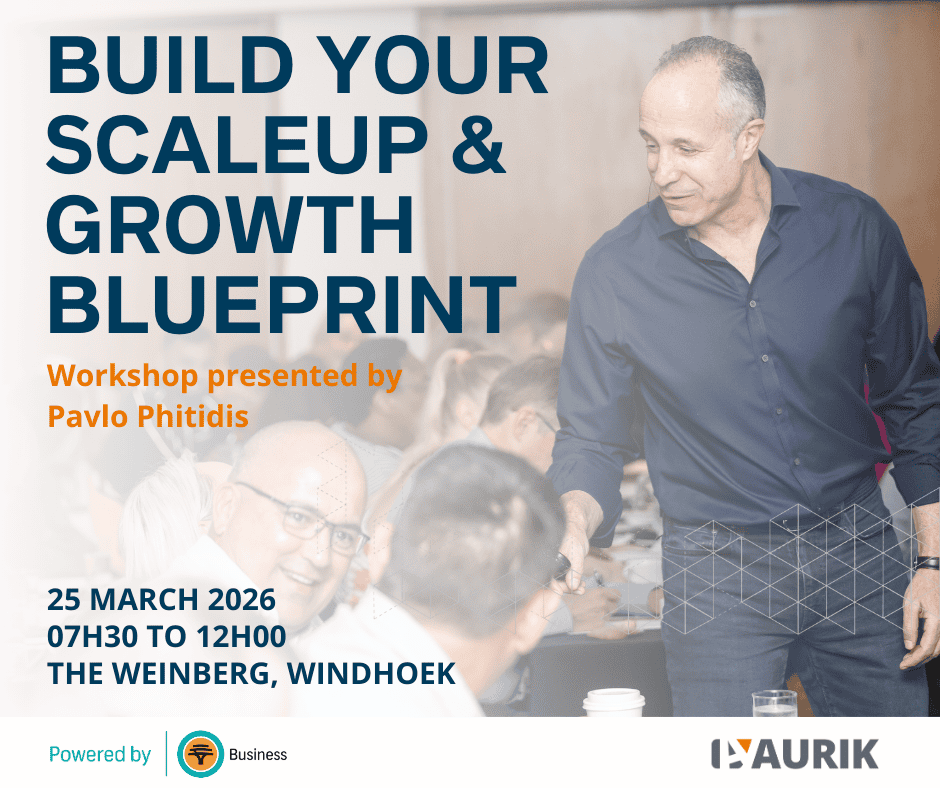
Download the details  for the Aurik build your scaleup and growth blueprint workshop Windhoek. 

Click on the button to download the diary entry and save it into your calendar. 

Date: 25 March 2026 
Time: 7.30 arrival for 8am start, until 12pm

We will be in touch nearer the time and look forward to seeing you there. 

blueprint workshop 25 March


Continue reading