
This Week@Work: The taking stock trilogy, WHO?
This Week@Work we’re closing our stock take by asking a tough question: Who should be leading growth in your business? Surely it should be the person who is most deeply invested in its success?

This Week@Work we’re closing our stock take by asking a tough question: Who should be leading growth in your business? Surely it should be the person who is most deeply invested in its success?

This Week@Work we’re getting to the second part of our annual stocktake, and need to ask ourselves: What are we doing differently today, than we did this time last year, to get our business to where it needs to go?

In this article, originally featured in Business Leader: In the fiercely competitive market, The Modern House is setting itself apart using rich, curated content and a design-centric approach
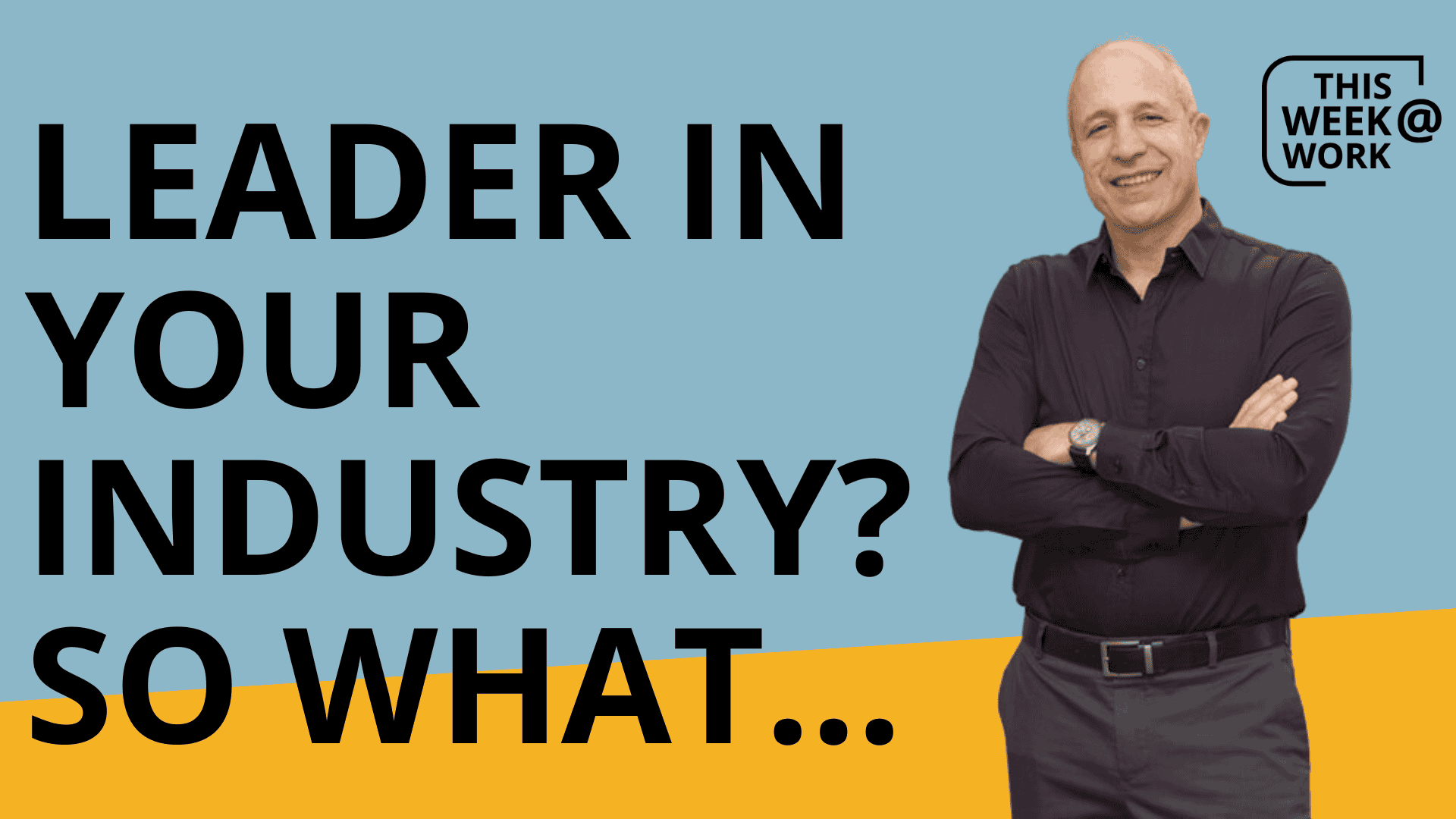
This Week@Work what does it mean to be a leader in your industry? You need to define and measure your specific sphere of leadership to lead your decision-making, manage your resources and align your team. Otherwise, it is just a hollow platitude.

In this article, originally featured in Business Leader: Meet the father and son duo aiming to take their family business, car dealership Romans International, to new heights

This Week@Work a stepwise analogy makes the point about scaling your business with the systems and processes to prepare for growth, and repeating that process continuously to keep growing your business, sustainably.

In the world of small businesses, defining and achieving industry leadership can be a complex but rewarding goal. This article discusses what it truly means to be a leader in your industry and outlines practical steps to move from a vague vision statement to a measurable and achievable business objective.
What Does It Mean to Be a Leading Business?
Many companies state in their vision or mission that they aim to be the leading business in their industry. However, when pressed to explain what “leading” actually means, business owners often struggle to provide a clear definition. Without a precise and measurable definition of leadership, this goal can become an empty claim.
The Importance of Clarity
To become a true industry leader, a business must first define what leadership means in its specific context. Is it about market share? If so, who constitutes the market? For example, if you are in the business of manufacturing luxury furniture, you need to break down what “luxury furniture” includes. Is it dining room tables, sofas, chairs, or lounges? Understanding your market and product specifics is crucial.
Setting Realistic and Measurable Goals
Let’s say your focus is on luxury dining room tables. The first step is to determine how many such tables are bought annually in your target market. If you identify that 500,000 dining room tables are sold each year in your defined geographic region, you then need to ascertain how many of these qualify as high-quality luxury items. Suppose 5,000 of these meet the high-quality standard. This gives you a tangible target to aim for.
Understanding Market Share
To claim industry leadership, you must know your competitors and their market shares. If you have ten competitors and the market is evenly split, each would sell about 500 tables annually. If your goal is to be the leading supplier, you need to sell more than 500 tables per year. By consistently increasing your sales figures—say from 500 to 600 to 1,000 to 1,500—you can objectively measure your progress towards market leadership.
Enhancing Business Operations
Achieving and maintaining a leading position requires continuous improvement in various aspects of your business. This includes enhancing the quality, price, service, delivery, durability, and brand reputation of your products. By systematically improving these areas, you can increase your market share and solidify your status as an industry leader.
Claiming to be the leading business in your industry is more than just a statement—it requires a clear, measurable, and achievable plan. By defining what leadership means in your specific context, understanding your market, setting realistic goals, and continually improving your business operations, you can move towards becoming a true leader in your industry.

“Boring businesses” often go unnoticed but hold valuable lessons in sustainability and success. Despite their lack of media attention and glamour, these businesses demonstrate critical principles that can benefit any industry.
Understanding Boring Businesses
Boring businesses are rarely in the spotlight. Examples include recycling operations or foam fabrication. Foam fabrication, for instance, involves purchasing large bales of foam, cutting and shaping them, and then supplying them to furniture and mattress manufacturers. While these industries may lack excitement, they are essential and well-established, often attracting little new investment or media coverage.
Key Lessons in Longevity
The primary advantage of boring businesses lies in their maturity and stability. These industries are typically entrenched with established suppliers and customers, creating a steady, if unremarkable, ecosystem. For instance, the foam fabrication industry relies on a few large suppliers, leaving little room for new entrants. Similarly, customers in these industries treat the products as commodities, focusing on price and convenience.
The Competitive Edge
In such markets, the key to success lies in efficiency and reliability. Using the foam fabricator example, companies that excelled were those that could deliver quickly and reliably. Initially, the ability to fabricate and deliver foam within a six-hour window was a significant competitive edge. However, as this became standard, the focus shifted to cost control and efficiency.
Embracing Innovation in Boring Industries
Despite their mundane nature, boring businesses present unique opportunities for innovation. While these businesses might be reluctant to invest in modernization, those that do can significantly distinguish themselves. By introducing efficient processes and modernizing their operations, these businesses can attract new talent and investment.
Take Away
Boring businesses, though often overlooked, provide critical insights into business longevity and success. They thrive on stability, efficiency, and cost control. For entrepreneurs, the key takeaway is that success doesn’t always come from exciting industries. Sometimes, the greatest opportunities lie in the most mundane sectors. By focusing on efficiency and embracing innovation, even the dullest business can become a beacon of success.


This full-morning workshop is designed for business owners ready to take their company to the next level. Be it scale-up growth, succession or an exit, walk out with a customised, actionable blueprint to attain your 3–5-year ambitions
Identify Your Growth Impediments:
Spot recurring impediments to growth and value and how to resolve them
Design Your Actionable Scaleup Blueprint:
Develop a three-to-five-year roadmap to deliver growth, improved value, and operational and management succession. Including:
“Real-world relatability to any business in any industry”

As an entrepreneur, Pavlo Phitidis cut his teeth in turnaround companies. Then spent a few years in M&A, which allowed him to conclude 68 transactions before answering a call of duty in a family business, which enabled his parents’ retirement.
Pavlo co-founded Aurik by directly starting, growing and exiting 12 businesses to develop a business growth system, which has worked with upwards of 3,500 established companies in 4 countries.
Pavlo is a passionate advocate for business as a force for good and has brought this to life through more than 1,200 radio segments, two books, Sweat, Scale $ell and Reset, Rebuild, Reignite and hundreds of articles for columns across business and lifestyle titles.
Daily, he works with private business owners, personally and through his company, to resolve growth and value challenges.

Johan is one of the directors of Aurik Business Cape Town & KZN.
Before investing in Aurik, Johan worked in mergers and acquisitions, where he saw the scale of the challenge facing business owners who believed they could sell their businesses.
Johan was already running his first business while qualifying for his B.Comm in Entrepreneurship. He subsequently started and built several companies across sectors including IT, Finance, Publishing and Digital marketing. For 10 years he ran a financing company that offered bridging and project finance, among other solutions. He spent 2 years in a large corporate, where he was a project manager on a range of FMCG projects. This accumulated experience developed his borderline-obsession with what he calls ‘the end game’: building a business so that it can be sold.
Leave with a practical, customised, actionable blueprint to implement in your business the next day, setting you on a clear path to achieving your ambitions.
“Very informative and simplified a complex process”

This full-morning workshop is designed for business owners ready to take their company to the next level. Be it scale-up growth, succession or an exit, walk out with a customised, actionable blueprint to attain your 3–5-year ambitions
Identify Your Growth Impediments:
Spot recurring impediments to growth and value and how to resolve them
Design Your Actionable Scaleup Blueprint:
Develop a three-to-five-year roadmap to deliver growth, improved value, and operational and management succession. Including:
“Real-world relatability to any business in any industry”
As an entrepreneur, Pavlo Phitidis cut his teeth in turnaround companies. Then spent a few years in M&A, which allowed him to conclude 68 transactions before answering a call of duty in a family business, which enabled his parents’ retirement.
Pavlo co-founded Aurik by directly starting, growing and exiting 12 businesses to develop a business growth system, which has worked with upwards of 3,500 established companies in 4 countries.
Pavlo is a passionate advocate for business as a force for good and has brought this to life through more than 1,200 radio segments, two books, Sweat, Scale $ell and Reset, Rebuild, Reignite and hundreds of articles for columns across business and lifestyle titles.
Daily, he works with private business owners, personally and through his company, to resolve growth and value challenges.
Johan is one of the directors of Aurik Business Cape Town & KZN.
Before investing in Aurik, Johan worked in mergers and acquisitions, where he saw the scale of the challenge facing business owners who believed they could sell their businesses.
Johan was already running his first business while qualifying for his B.Comm in Entrepreneurship. He subsequently started and built several companies across sectors including IT, Finance, Publishing and Digital marketing. For 10 years he ran a financing company that offered bridging and project finance, among other solutions. He spent 2 years in a large corporate, where he was a project manager on a range of FMCG projects. This accumulated experience developed his borderline-obsession with what he calls ‘the end game’: building a business so that it can be sold.
Leave with a practical, customised, actionable blueprint to implement in your business the next day, setting you on a clear path to achieving your ambitions.
“Very informative and simplified a complex process”